
Introduction: When a Technical-Looking Name Creates Confusion
The digital design world contains countless file names, identifiers, project labels, and asset references. Some are immediately understandable, while others look like combinations of numbers and letters with no obvious explanation. 1.5f8-p1uzt texture belongs to the second category and deserves a careful, context-first approach.
The most important thing to understand about an unfamiliar digital term is that its name does not automatically prove what it represents. A label can be an internal identifier, a project reference, a filename, a generated value, or a description used by a particular website.
That is why researching 1.5f8-p1uzt texture should begin with questions rather than assumptions. Where did the term appear? Is there an actual file behind it? What format does that file use? Is there documentation from an identifiable source? Can its claimed purpose be independently confirmed?
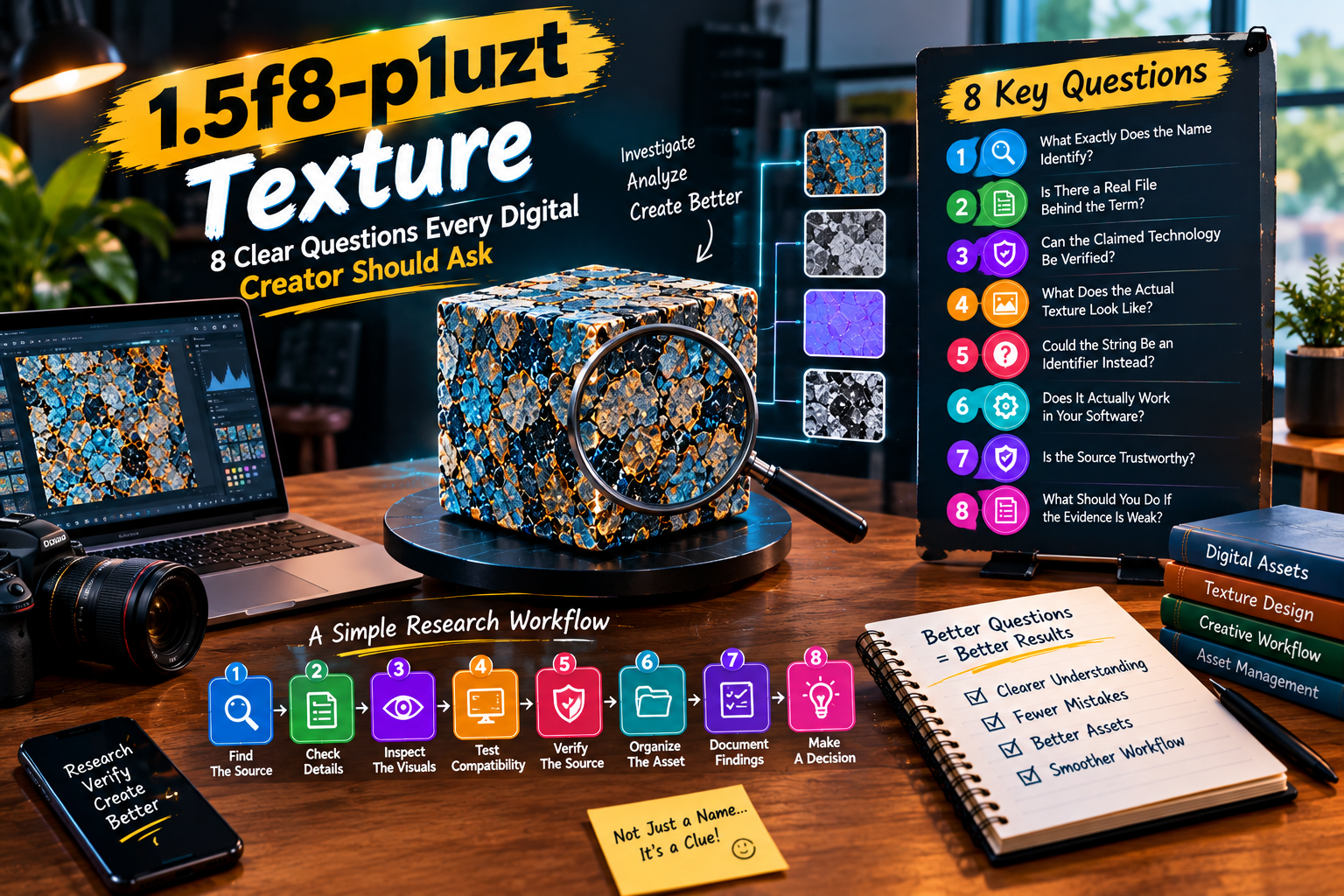
This guide uses eight practical questions to create a clearer research path.
Question 1: What Exactly Does the Name Identify?
The first question is simple: what does 1.5f8-p1uzt texture actually point to?
A technical-looking string may appear beside an image, inside a project folder, in an article, within software documentation, or as part of an automatically generated filename. These situations are very different.
If the term is connected to an actual image, inspect the image file. If it appears in a project document, examine the surrounding references. If it appears only in an article without an identifiable underlying asset, treat the description cautiously.
The exact source matters because the same unusual string can be interpreted differently depending on where it is found.
Why Context Comes First
Context tells you whether you are looking at a real asset, an identifier, or simply a phrase used by a webpage. Without that information, it is easy to mistake a label for a standardized technology.
When researching 1.5f8-p1uzt texture, preserving the original context is therefore one of the most useful first steps.
Question 2: Is There a Real File Behind the Term?
A genuine texture normally exists as some type of digital resource. If someone describes 1.5f8-p1uzt texture as a special texture format, the next step should be to look for evidence of an actual file type or specification.
Check the file extension, file properties, metadata, documentation, or software that supposedly opens the resource.
This distinction is important because “texture” can describe a visual role without being the name of a file format. A texture may be stored in a familiar image container while being used as part of a material or rendering workflow.
File Extension vs. Asset Role
A file extension describes how data is packaged. An asset role describes how that resource is used. These are not necessarily the same thing.
For 1.5f8-p1uzt texture, confirming the actual file type is more useful than assuming that the unusual label itself represents a proprietary format.
Question 3: Can the Claimed Technology Be Verified?
Search results can sometimes repeat the same technical claim across multiple websites. Repetition alone does not make a claim authoritative.
When investigating 1.5f8-p1uzt texture, look for an identifiable developer, vendor, technical specification, documentation page, or established software implementation.
A real technical standard normally leaves evidence behind. There may be documentation, supported software, examples, version information, or a clearly identified organization responsible for it.
If those elements are missing, the correct approach is to mark the claim as unverified rather than automatically treating it as fact.
Beware of Specific-Sounding Details
Claims about compression methods, bit depth, GPU optimization, compatibility, or proprietary algorithms can sound convincing because they use technical vocabulary. But technical language is not evidence by itself.
If a page claims that 1.5f8-p1uzt texture has a particular feature, look for an independent source that documents the same feature.
Question 4: What Does the Actual Texture Look Like?
If you have a real visual asset associated with 1.5f8-p1uzt texture, inspect the asset itself rather than relying only on its name.
Look at:
- Overall pattern
- Color distribution
- Surface detail
- Contrast
- Repetition
- Edge behavior
- Resolution
- Compression artifacts
A texture should be evaluated according to the project where it will be used.
Read more: About Software Wuvdbugflox: 9 Smart Research Stages for Better Understanding
Test at Different Sizes
View the asset as a complete image, at its expected working size, and at a closer zoom. This can reveal different characteristics.
A surface that looks detailed when enlarged may appear perfectly ordinary at normal size. Conversely, compression problems that are invisible in a thumbnail may become obvious after scaling.
The visual characteristics of 1.5f8-p1uzt texture should therefore be judged from the actual resource whenever one is available.
Question 5: Could the String Be an Identifier Instead?
One of the most useful possibilities to investigate is whether the unusual label is an identifier rather than a texture format.
Modern software systems frequently use machine-readable identifiers for assets, cached resources, generated files, or internal references. Such strings may look random because their purpose is to uniquely distinguish one item from another.
If 1.5f8-p1uzt texture appears inside a project, search the surrounding files and folders before assuming it represents a new technology.
Search the Project
A project-wide search can reveal where the string is referenced. It may appear in metadata, configuration files, logs, cache directories, or asset records.
The location can provide an important clue about its role.
Check the File Path
A file located in a cache directory should not automatically be interpreted as a source asset. Similarly, a value inside metadata may function as a reference rather than a visual resource.
This is why the identifier-versus-asset distinction is so important.
Question 6: Does It Actually Work in Your Software?
Even if a resource appears legitimate, compatibility should be tested rather than assumed.
When working with 1.5f8-p1uzt texture, identify the software that is expected to open, edit, import, or display the underlying asset.
Check whether the file can be imported normally. Observe whether dimensions, transparency, color, and visual details remain intact.
If a website claims that a special format is supported by a major application, verify that claim through the application’s own documentation when possible.
A Simple Compatibility Test
Use a copy of the resource and perform a basic import. Then check:
- Does the software recognize the file?
- Does the preview appear correctly?
- Are colors preserved?
- Are dimensions correct?
- Can the file be exported again?
- Does the resulting asset behave as expected?
This test can quickly separate a practical resource from an unsupported claim.
Question 7: Is the Source Trustworthy?
Source quality is especially important when unusual technical information is involved.
Before downloading or using anything associated with 1.5f8-p1uzt texture, investigate where the information or file originated.
Look for:
- An identifiable publisher
- Official documentation
- Clear authorship
- Technical references
- Licensing information
- Consistent terminology
- Evidence from independent sources
Be particularly careful with pages that make very specific technical claims without identifying a developer, specification, or implementation.
Keep Source Records
If you find a legitimate asset, save its source information with your project. This can include the original page, creator, license, and date reviewed.
For 1.5f8-p1uzt texture, keeping this record is useful because unusual identifiers can be difficult to trace again later.
Question 8: What Should You Do If the Evidence Is Weak?
Not every digital mystery can be solved immediately. Sometimes the available information is incomplete or contradictory.
If the evidence surrounding 1.5f8-p1uzt texture is weak, do not fill the gaps with invented specifications.
Instead, create three categories:
Confirmed
Information directly supported by the original file or reliable documentation.
Possible
Reasonable interpretations that still require confirmation.
Unknown
Questions for which no reliable evidence is currently available.
This approach gives you a much more accurate asset record.
It also prevents an unverified description from becoming a permanent part of your project’s documentation.
A Practical Research Workflow
After asking the eight questions above, the process can be condensed into a simple workflow for 1.5f8-p1uzt texture.
Step 1: Locate the Original Reference
Find the first place where the term appeared.
Step 2: Preserve the Exact Name
Record the identifier without modifying it.
Step 3: Find the Underlying Resource
Determine whether an actual file, image, material, or metadata record exists.
Step 4: Inspect the Technical Details
Check extension, dimensions, file size, metadata, and related information.
Step 5: Examine the Visual Result
Look at the texture at realistic working sizes.
Step 6: Test Compatibility
Use a duplicate and test the resource in the intended software.
Step 7: Verify the Source
Look for authoritative documentation or identifiable ownership.
Step 8: Record the Result
Document what is confirmed and what remains uncertain.
This process keeps research efficient without forcing a conclusion before enough evidence exists.
How to Avoid Common Research Mistakes
Researching 1.5f8-p1uzt texture can become confusing when several common mistakes occur.
Mistake 1: Believing the First Search Result
A search result is a starting point, not automatic proof.
Mistake 2: Confusing Repetition With Authority
Five websites repeating the same unsupported sentence do not necessarily provide five independent confirmations.
Mistake 3: Assuming Technical Vocabulary Is Proof
Words such as “compression,” “rendering,” “GPU,” and “optimization” can appear in inaccurate descriptions too.
Mistake 4: Ignoring the Actual File
If a supposed texture format exists, there should be some way to identify and test the underlying resource.
Mistake 5: Editing Before Verification
Never modify the only copy of an unfamiliar asset before understanding what it is.
Mistake 6: Forgetting Licensing
Even a technically useful asset may have usage restrictions.
For 1.5f8-p1uzt texture, these precautions make the research process more dependable.
A Better Way to Document the Result
Once your investigation is complete, create a short asset report.
A useful report for 1.5f8-p1uzt texture can contain:
Identifier: Exact original name
Source: Original location
File Type: Verified extension
Dimensions: Confirmed size
Visual Description: Observable characteristics
Software: Tested environment
License: Verified status
Evidence: Supporting documentation
Confidence: Confirmed, possible, or unknown
Notes: Remaining questions
This format is easy to maintain and can be shared with teammates.
It also prevents future users from assuming that an old project note is an official technical specification.
Read more: The Importance of Personalized Dosing in Anesthesia
Why a Cautious Approach Is More Useful
The goal of digital research is not to produce the most complicated explanation. It is to produce the most defensible explanation supported by available evidence.
For 1.5f8-p1uzt texture, this means separating the visual concept of a texture from claims about a proprietary format or technology.
If an actual asset exists, evaluate that asset. If the term appears only as an identifier, investigate its surrounding project. If a source claims that the term represents a formal standard, look for independent technical documentation.
This approach saves time because it prevents creators from building workflows around unsupported assumptions.
Final Thoughts
Unusual digital terminology can look more complicated than it really is. 1.5f8-p1uzt texture should therefore be approached as a research question rather than an automatic definition.
The most useful strategy is to identify the original context, locate the underlying resource, inspect its actual properties, test compatibility, verify the source, and document the evidence.
If the term ultimately turns out to be an internal identifier, the investigation has still been valuable because you now understand its role. If it refers to an actual digital asset, the same process helps determine whether that asset is suitable for your project.
The key lesson is simple: let the evidence define the resource. A mysterious name may start the investigation, but the actual file, documentation, software behavior, and source history should determine what you can confidently say about it.
