
Modern applications need more than attractive interfaces. Behind every reliable website, application, automation platform, and digital service is a backend responsible for processing requests, managing information, connecting services, and maintaining system operations. This is where the question what is osgartop0.9.6.3 becomes interesting for developers and technology readers exploring lightweight backend solutions.
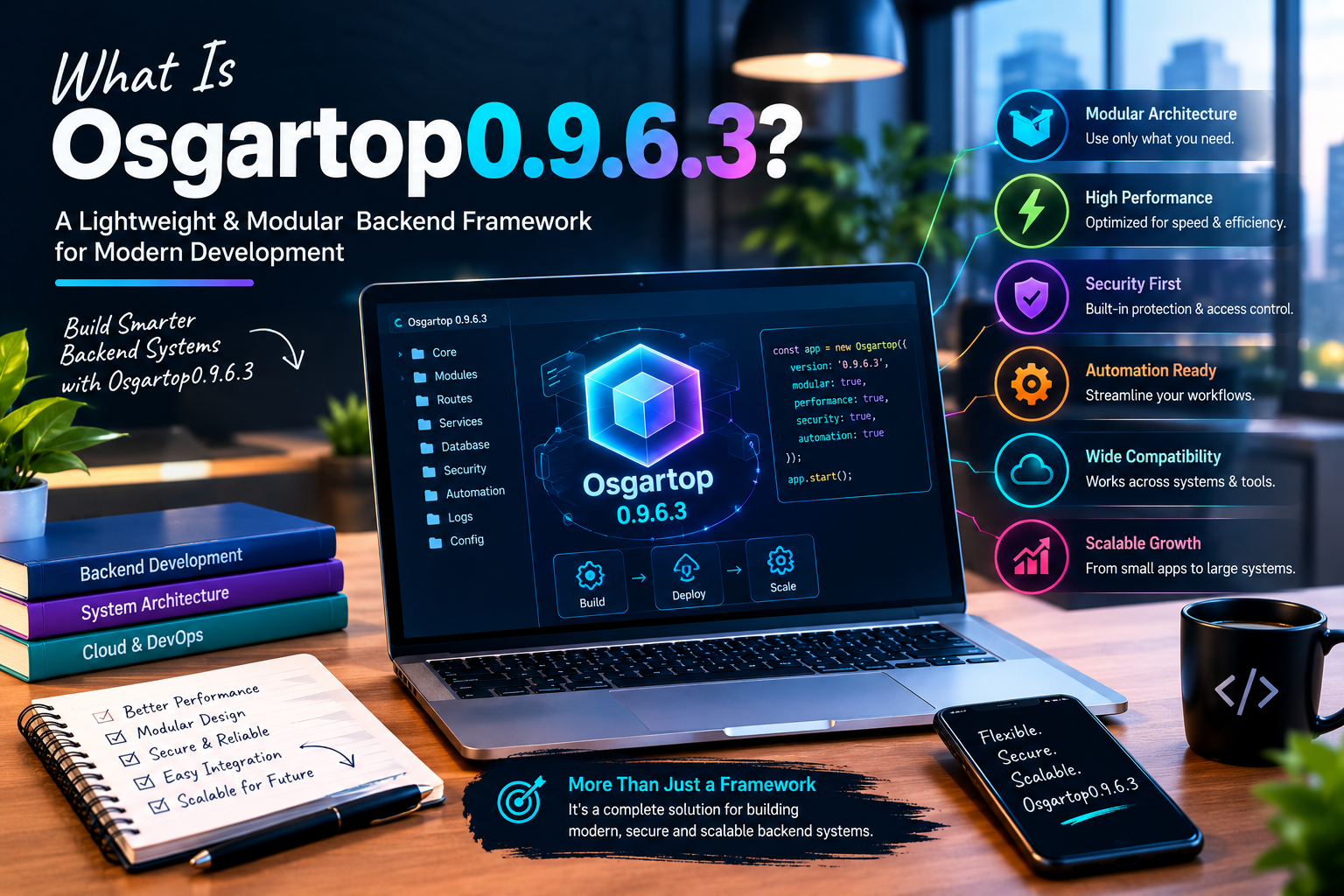
Osgartop0.9.6.3 is presented as a lightweight and modular backend framework designed around performance, flexibility, automation, integration, security, and scalability. Instead of approaching backend development as one large collection of features, its concept emphasizes separate components that can be organized according to project requirements.
This article provides a fresh perspective on what is osgartop0.9.6.3, focusing less on a simple feature list and more on how such a framework can fit into a modern development workflow.
Start With the Real Backend Problem
Before understanding what is osgartop0.9.6.3, it is useful to understand why developers need backend frameworks in the first place.
Building a server-side application from scratch can involve many separate responsibilities. Developers may need to manage requests, authentication, databases, application logic, error handling, logging, integrations, and deployment.
Without an organized framework, these responsibilities can become difficult to maintain as a project grows.
Why Complexity Increases
A small application may initially require only a few functions.
As users, features, integrations, and data increase, the backend can become considerably more complicated.
Developers then need to think about:
- Performance
- Reliability
- Security
- Scalability
- Resource consumption
- Maintenance
- Integration
- Monitoring
The approach associated with what is osgartop0.9.6.3 attempts to address these concerns through a lightweight and modular architecture.
The Core Idea Behind Osgartop0.9.6.3
The easiest way to understand what is osgartop0.9.6.3 is to view it as a framework intended to organize backend functionality efficiently.
The framework is described as modular, meaning different components can potentially be selected and managed according to application needs.
This approach can be useful when developers want to avoid carrying unnecessary functionality into every project.
Why Lightweight Design Matters
Software does not operate in an unlimited environment.
Applications may run on cloud servers, virtual machines, containers, dedicated hardware, or resource-constrained systems.
A lightweight framework can potentially reduce unnecessary overhead and make resource management easier.
Efficiency Is Not the Same as Speed
One important distinction is that lightweight architecture does not automatically guarantee that every application will be faster.
Performance depends on many factors, including:
- Application code
- Hardware
- Database design
- Network conditions
- Configuration
- Workload
- External services
Therefore, what is osgartop0.9.6.3 should be evaluated through real-world testing rather than assumptions.
A Different Look at the Modular Architecture
One of the most interesting areas of what is osgartop0.9.6.3 is modularity.
A modular system divides functionality into separate parts rather than treating the entire backend as one inseparable block.
The Practical Advantage
Imagine a project that requires API handling, authentication, logging, and automation but does not need every available backend component.
A modular architecture may allow developers to concentrate on the functionality that matters.
Easier Maintenance
When responsibilities are separated, developers can potentially locate problems more quickly.
A change to one component may also be easier to manage than a change affecting an entire application.
This is particularly useful as projects become larger.
Read more: 30.6df496–j261x5: 9 Essential Clues to Decode an Unfamiliar Digital Reference
Modularity and Teamwork
Modular architecture can also support collaboration.
Different developers may work on different components while following clearly defined interfaces and responsibilities.
This can reduce confusion and make larger development projects easier to organize.
Performance From a Developer’s Perspective
Another important part of what is osgartop0.9.6.3 is its focus on performance optimization.
Backend performance affects how quickly applications respond to users and services.
A slow backend can create delays throughout an application, even when the frontend is well designed.
Areas That Influence Performance
A developer evaluating performance might monitor:
| Area | What to Observe |
|---|---|
| CPU | Processing demand |
| Memory | RAM consumption |
| Response time | Request completion speed |
| Throughput | Requests handled over time |
| Latency | Delay between request and response |
| Errors | Failed operations |
| Scalability | Behavior under increasing demand |
These measurements provide a more realistic picture than a general statement that a framework is “fast.”
Testing Different Workloads
A backend should ideally be tested under different conditions.
For example, a small development project may behave perfectly with ten users but experience problems under significantly higher traffic.
This is why what is osgartop0.9.6.3 should be considered in relation to the actual workload of a project.
Automation as a Development Advantage
Modern software teams increasingly rely on automation.
Manual processes can consume time and introduce repetitive work.
The framework’s described emphasis on automation makes it potentially relevant to applications involving repeated workflows and backend tasks.
What Can Automation Improve?
Automation can help with tasks such as:
- Scheduled processes
- Data handling
- Workflow execution
- Repetitive backend operations
- System notifications
- Process monitoring
Automation Needs Control
Automation is useful only when it is predictable and properly monitored.
A poorly configured automated task can repeat an error just as efficiently as it performs a correct operation.
For this reason, developers studying what is osgartop0.9.6.3 should consider logging, permissions, testing, and recovery procedures alongside automation.
Integration With Other Technologies
No modern backend usually exists completely by itself.
Applications commonly communicate with databases, APIs, authentication providers, cloud services, analytics systems, and other software.
This makes integration an important consideration when exploring what is osgartop0.9.6.3.
The Integration Challenge
Different platforms may use different:
- Protocols
- Authentication methods
- Data formats
- Dependencies
- Versions
- Configuration systems
A framework that supports flexible integration can simplify the architecture.
Test Every Important Connection
Even if a framework is designed for compatibility, developers should test each external dependency in the intended environment.
A successful connection during development does not always guarantee identical behavior in production.
Security Should Be Built Into the Process
Security is another area to consider when asking what is osgartop0.9.6.3.
Backend systems often handle sensitive application data, user accounts, credentials, transactions, or business processes.
The source describes security-related capabilities involving authentication, access control, and data integrity.
Authentication vs. Authorization
These two concepts are related but different.
Authentication determines whether a user or service is who it claims to be.
Authorization determines what that authenticated entity is allowed to access or change.
A secure backend needs both concepts to be handled appropriately.
Other Security Considerations
Developers should also think about:
- Input validation
- Secure credentials
- Permission management
- Dependency updates
- Logging
- Secret management
- Error handling
- Monitoring
A framework can provide useful tools, but secure application development still depends heavily on correct implementation.
Scalability: Planning Beyond the First Version
A project may start small but grow quickly.
This makes scalability another useful perspective on what is osgartop0.9.6.3.
Scalability refers to how effectively a system can handle increasing demand.
What Can Cause Growth?
Growth can come from:
- More users
- More requests
- Larger datasets
- Additional integrations
- New application features
- Higher transaction volumes
A backend architecture should therefore be evaluated not only for current requirements but also for realistic future needs.
Horizontal and Vertical Growth
Systems can sometimes scale by increasing the resources of one machine or by distributing workloads across multiple resources.
The best approach depends on application architecture and infrastructure.
A Simple Project Evaluation Framework
Instead of immediately deciding whether what is osgartop0.9.6.3 is suitable for a project, developers can use a structured evaluation.
Step 1: Define the Application
Write down what the application actually needs.
For example:
- API services
- Authentication
- Database communication
- Automation
- Monitoring
- External integrations
Step 2: Identify Resource Requirements
Estimate expected CPU, memory, storage, and network requirements.
Step 3: Build a Prototype
Create a small working application rather than testing the framework only through documentation.
Step 4: Measure Performance
Record response times, resource usage, errors, and throughput.
Step 5: Test Security
Review authentication, authorization, configuration, and access controls.
Step 6: Test Integrations
Connect the external services required by the actual application.
Step 7: Review Maintenance
Consider how easy it will be for developers to update, monitor, troubleshoot, and maintain the system.
This process makes the investigation of what is osgartop0.9.6.3 much more practical.
Where Could This Framework Fit?
The framework’s described characteristics can potentially make it relevant to several development scenarios.
API-Based Applications
APIs provide communication between software systems.
A backend framework can provide structure for request processing, authentication, business logic, and data access.
Business Systems
Organizations often need applications that connect several internal processes.
A modular backend can potentially help separate different responsibilities.
Automated Workflows
Applications involving repeated operations may benefit from automation capabilities.
Examples include scheduled processing, notifications, data workflows, and routine system tasks.
Educational Projects
A backend framework can also be useful as a learning environment.
Students can experiment with:
- API design
- Server-side programming
- Authentication
- Databases
- Monitoring
- Automation
- System architecture
This practical angle is another reason developers may search for what is osgartop0.9.6.3.
Version Numbers and What They Tell Developers
The version identifier itself deserves attention.
When developers see a version such as 0.9.6.3, they may wonder what each number represents.
Versioning systems vary between projects, so the numbers should not automatically be interpreted according to one universal rule.
Why Version Tracking Matters
Software versions help teams understand which release they are using.
They can also assist with:
- Upgrade planning
- Compatibility checks
- Bug tracking
- Documentation
- Deployment management
For a development-stage project, version information can be particularly important because functionality and compatibility may change over time.
Read more: Safe Pest Control Solutions for Homes with Kids and Pets
A Useful Strengths-and-Challenges View
A balanced understanding of what is osgartop0.9.6.3 requires looking at both potential advantages and practical challenges.
| Potential Strength | Possible Challenge |
|---|---|
| Modular architecture | More components can require planning |
| Lightweight design | Performance still needs testing |
| Automation | Automated processes need monitoring |
| Integration focus | External dependencies can fail |
| Scalability | Scaling requires proper architecture |
| Security features | Configuration remains important |
| Diagnostics | Logs need proper management |
This balanced approach is more useful than presenting any technology as a perfect solution.
Common Mistakes During Adoption
Developers researching what is osgartop0.9.6.3 may be tempted to start with installation immediately.
A better approach is to understand the requirements first.
Mistake One: Choosing Technology Before Defining the Problem
A framework should solve a project’s requirements rather than becoming the requirement itself.
Mistake Two: Ignoring Documentation
Documentation provides information about supported environments, configuration, dependencies, and limitations.
Mistake Three: Skipping Performance Tests
A framework that performs well in one environment may behave differently in another.
Mistake Four: Treating Security as an Add-On
Security should be considered throughout development.
Mistake Five: Moving Directly to Production
A controlled prototype provides an opportunity to discover problems before they affect real users.
A Beginner-Friendly Learning Path
Someone new to backend development can approach what is osgartop0.9.6.3 through a gradual learning process.
First, Learn Backend Fundamentals
Understand requests, responses, APIs, databases, authentication, and server-side logic.
Next, Study Framework Architecture
Learn how modules, components, configuration, and application logic interact.
Then Build a Small Project
A simple API or automation project is enough to explore the framework’s basic concepts.
Finally, Experiment With Scaling
Once the basics work, test larger workloads, external integrations, monitoring, and security controls.
This learning path helps beginners understand the framework instead of simply copying configuration examples.
How to Decide Whether It Fits Your Project
The most useful question is not simply what is osgartop0.9.6.3, but whether its architecture matches the requirements of your application.
Consider the following:
Need modularity?
A component-based approach may be useful.
Need lightweight deployment?
Evaluate actual memory and CPU requirements.
Need automation?
Test workflows and monitoring.
Need integrations?
Verify every required external service.
Need scalability?
Perform realistic load testing.
Need strong security?
Review authentication, permissions, configuration, and monitoring.
Frequently Asked Questions
What is osgartop0.9.6.3?
The phrase what is osgartop0.9.6.3 refers to Osgartop0.9.6.3, which is presented as a lightweight, modular backend framework focused on performance, automation, integration, security, and scalability.
Is Osgartop0.9.6.3 a backend framework?
Yes. Osgartop0.9.6.3 is described as a backend framework intended to support server-side application development and related system operations.
What makes Osgartop0.9.6.3 different?
Its described focus on modular architecture and lightweight resource usage is a notable part of its approach.
Is Osgartop0.9.6.3 suitable for large applications?
It is described with scalability and enterprise-oriented use cases in mind, but suitability for a specific large application should be established through testing.
Does Osgartop0.9.6.3 support automation?
Automation and workflow management are among the capabilities associated with the framework.
Is Osgartop0.9.6.3 secure?
The framework is described as including security-related mechanisms such as authentication and access controls. However, overall application security also depends on correct configuration and development practices.
Can developers integrate external services?
The framework is described as supporting integration with third-party tools and different environments. Developers should verify compatibility with the exact services required by their project.
Final Thoughts
So, what is osgartop0.9.6.3? It is presented as a lightweight, modular backend framework designed to help developers build systems with an emphasis on efficiency, flexibility, automation, security, integration, and scalability.
Its modular approach is particularly interesting because backend applications often become difficult to maintain when every component is tightly connected. Separating functionality can make it easier to organize development and manage future changes.
At the same time, no framework should be selected solely because it sounds powerful or modern. Developers should evaluate real requirements, create prototypes, measure performance, test integrations, review security, and consider long-term maintenance.
For anyone exploring what is osgartop0.9.6.3, the most valuable takeaway is that understanding a backend framework requires looking beyond its name and version number. Its architecture, resource requirements, development workflow, security model, integration options, and scalability should all be considered.
A careful evaluation can reveal whether the framework genuinely fits a particular project or whether another backend approach would be more appropriate. That evidence-based process is ultimately more valuable than relying on assumptions or promotional descriptions.
