
Introduction
Online information can move extremely fast, especially when a topic involves unusual identifiers, alleged leaks, cybersecurity discussions, or controversial claims. Thejavasea.me leaks aio-tlp370 is one such phrase that may attract attention from people searching for explanations, background information, or verification.
The challenge is that online visibility does not automatically make a claim accurate. A search result, screenshot, repost, or anonymous statement may provide a starting point for research, but it should not automatically be treated as established evidence.
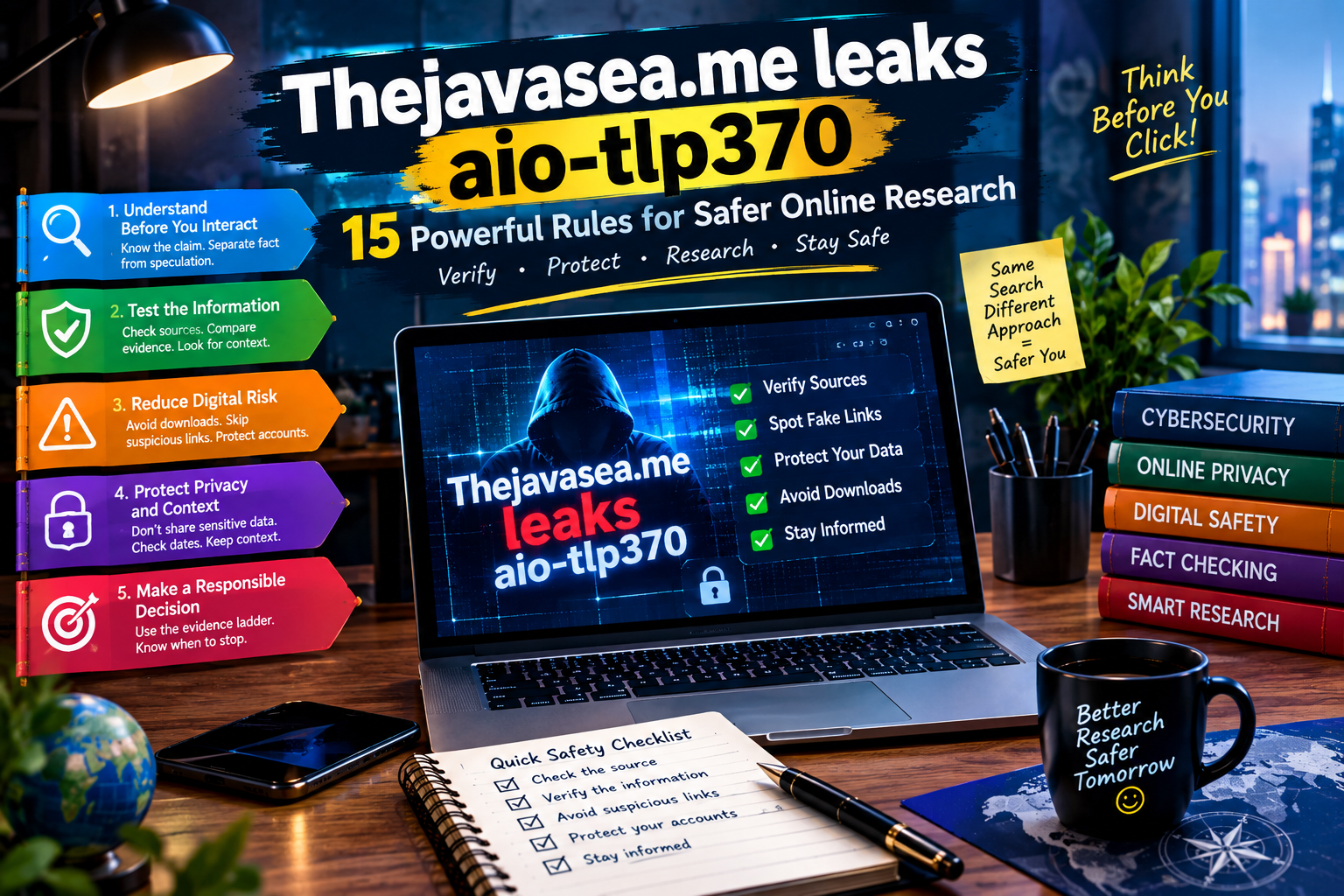
This guide introduces a practical five-layer safety map containing 15 rules for responsible digital research. The goal is not to access questionable material. Instead, it is to understand how to evaluate claims, protect personal information, recognize warning signs, and make better decisions when researching unfamiliar online topics.
Layer One: Understand Before You Interact
Rule 1: Define the Claim
The first rule when researching Thejavasea.me leaks aio-tlp370 is to identify exactly what is being claimed.
Do not begin with assumptions. Write down the basic claim in neutral language and separate it from comments, speculation, or dramatic descriptions surrounding it.
Ask:
- What supposedly happened?
- Who made the claim?
- When was it published?
- What evidence was provided?
- Can the original source be identified?
This simple process prevents a headline from becoming a conclusion before the evidence has been examined.
Rule 2: Separate the Website From the Claim
A common research mistake is assuming that mentioning a website proves everything associated with it.
When Thejavasea.me leaks aio-tlp370 appears in a post, the website reference and the alleged event should be considered separately. A page can exist while information connected with it remains incomplete, inaccurate, outdated, or unverified.
Treat the website, the identifier, and the allegation as three separate research elements.
Rule 3: Avoid Filling Missing Information With Assumptions
Searchers may encounter gaps while researching Thejavasea.me leaks aio-tlp370. Those gaps should remain gaps until credible evidence fills them.
For example, an unfamiliar code may look technical without having a publicly established meaning. A screenshot may look convincing without proving its date or origin.
Good research accepts uncertainty instead of inventing an explanation simply because one sounds plausible.
Layer Two: Test the Information
Rule 4: Find the Earliest Available Source
When Thejavasea.me leaks aio-tlp370 appears across several pages, trace the information backward.
The newest article may simply be repeating an older post. Several websites can therefore create the appearance of widespread confirmation while ultimately relying on the same original statement.
Look for:
- Original publication
- Author or publisher
- Date and time
- Direct documentation
- Clear attribution
- Independent reporting
Source tracing is more useful than counting how many pages contain the same sentence.
Read more: Cruzdid Com: 9 Smart Insights Into Its Content, Features & Online Experience
Rule 5: Compare Independent Sources
Another important rule for Thejavasea.me leaks aio-tlp370 is to distinguish independent confirmation from simple repetition.
Two sources are more useful when they independently provide relevant information. If one article copies another article almost word for word, they should not automatically be treated as separate evidence.
Compare wording, timestamps, attribution, and supporting details before deciding how much confidence a claim deserves.
Rule 6: Treat Screenshots as Supporting Material
Screenshots related to Thejavasea.me leaks aio-tlp370 may appear persuasive, but an image alone does not always establish authenticity.
A screenshot can be:
- Cropped
- Edited
- Misdated
- Taken out of context
- Missing the original source
Whenever possible, investigate the source behind the screenshot. Look for surrounding information rather than relying on an isolated image.
Layer Three: Reduce Digital Risk
Rule 7: Do Not Download Unknown Files
One of the most important safety rules around Thejavasea.me leaks aio-tlp370 is to avoid downloading questionable archives or files simply because they are presented as evidence.
A file with a convincing name can still be unrelated, incomplete, manipulated, or unsafe.
You do not need to open an unknown archive to determine whether an online claim deserves further investigation. Reliable public information and source analysis are usually safer starting points.
Rule 8: Never Exchange Credentials for Curiosity
Research involving Thejavasea.me leaks aio-tlp370 should never become a reason to provide passwords, authentication codes, or other sensitive account information to unfamiliar websites.
Be especially cautious when a page asks you to:
- Log in unexpectedly
- Provide a password
- Enter a verification code
- Upload personal documents
- Disable security settings
A legitimate research process should not require unnecessary exposure of your private credentials.
Rule 9: Pay Attention to Redirects and Pop-Ups
While investigating Thejavasea.me leaks aio-tlp370, unexpected redirects or aggressive pop-ups should be treated as warning signs.
A page that repeatedly sends visitors to unrelated websites may be prioritizing traffic or advertising over useful information.
If a browsing session suddenly becomes unusual, close the questionable page instead of repeatedly interacting with it.
Layer Four: Protect Privacy and Context
Rule 10: Do Not Reproduce Sensitive Information
Information connected with Thejavasea.me leaks aio-tlp370 may potentially involve names, addresses, emails, credentials, documents, or other personal details.
Responsible research should avoid unnecessarily reproducing such information.
Even when something appears online, copying and redistributing it can increase exposure. A useful article can discuss the existence and implications of a claim without publishing sensitive personal material.
Privacy should remain part of the research process from the beginning.
Rule 11: Check the Date Before Sharing
Old information can create confusion when it is presented as current.
When researching Thejavasea.me leaks aio-tlp370, check publication dates, update dates, screenshots, and references to earlier events.
An old post resurfacing today does not necessarily represent a new development.
Before sharing an article or social post, determine whether the information is current, historical, or simply being recirculated.
Rule 12: Preserve the Original Context
Short quotes and cropped screenshots can change how a statement is understood.
For Thejavasea.me leaks aio-tlp370, context may include the original page, surrounding text, publication date, author, and reason the material was posted.
Removing those details can make uncertain information appear more definitive than it actually is.
A responsible researcher therefore tries to understand the complete context before reaching a conclusion.
Layer Five: Make a Responsible Decision
Rule 13: Use an Evidence Ladder
A practical way to evaluate Thejavasea.me leaks aio-tlp370 is to place information on an evidence ladder.
Step 1 — Mention
The phrase appears somewhere online.
Step 2 — Specific Claim
A source provides a particular allegation or explanation.
Step 3 — Supporting Material
The source provides documentation or other material that can be examined.
Step 4 — Independent Corroboration
Separate credible sources provide consistent information.
Step 5 — Established Information
Reliable primary or authoritative documentation supports the relevant details.
Not every online claim reaches the final level. Keeping these stages separate helps prevent premature conclusions.
Rule 14: Know When to Stop Researching
More searching does not always produce better information.
If Thejavasea.me leaks aio-tlp370 leads repeatedly to the same unsupported statements, continuing to open increasingly questionable pages may increase risk without improving understanding.
A sensible stopping point is reached when:
- Available sources repeat the same information
- No stronger evidence appears
- New pages add speculation rather than facts
- Security risks begin increasing
- Personal information becomes involved
Stopping is sometimes part of good research.
Rule 15: Record What Is Known and Unknown
The final rule for Thejavasea.me leaks aio-tlp370 is to separate confirmed information from unresolved questions.
Create two simple lists.
What Is Known
Record information that can be supported by identifiable and credible sources.
What Is Unknown
Record claims that remain unsupported, unclear, disputed, or difficult to verify.
This approach is especially useful when an online topic develops quickly. It prevents uncertain information from silently becoming part of your “known facts.”
A Five-Minute Safety Routine
Researching Thejavasea.me leaks aio-tlp370 does not need to become a complicated process. A five-minute routine can provide a useful first assessment.
Minute One: Read the Claim
Understand exactly what the page is saying.
Minute Two: Find the Source
Identify who published the information and when.
Minute Three: Compare
Search for genuinely independent reporting or documentation.
Minute Four: Check Risk
Avoid suspicious downloads, login requests, redirects, and unnecessary personal-data exposure.
Minute Five: Decide
Classify the information as verified, partially supported, or unverified.
This routine makes online research more structured and less reactive.
Warning Signs That Deserve Extra Attention
When Thejavasea.me leaks aio-tlp370 appears on an unfamiliar page, several warning signs can justify extra caution.
Anonymous Authority
The page claims expertise but provides no meaningful attribution.
Extreme Urgency
The visitor is pressured to act immediately.
Suspicious Downloads
The page strongly encourages an unknown archive or executable file.
Unusual Login Requests
A basic article suddenly requires account credentials.
Missing Dates
Important claims have no publication or update information.
Circular References
Multiple pages cite each other rather than independent evidence.
Unsupported Technical Language
Complicated terminology is used without explaining what it means.
None of these signs proves that a claim is false. They simply indicate that additional verification is appropriate.
Read more: Lighting Techniques in 3D: Enhancing Realism and Mood
Why Responsible Research Is Different From Simple Searching
Searching finds information. Research evaluates it.
That distinction matters when dealing with Thejavasea.me leaks aio-tlp370 because search engines can return a mixture of news articles, social posts, copied pages, forums, advertisements, and unrelated references.
A search result should therefore be treated as an entry point rather than a final answer.
The stronger process is:
Search → Identify → Compare → Verify → Protect → Conclude
This workflow can be applied to many cybersecurity-related topics, not just one unusual phrase.
Common Mistakes to Avoid
People researching Thejavasea.me leaks aio-tlp370 may make several predictable mistakes.
The first is assuming that a technical-looking identifier must have an official meaning.
The second is treating a large number of search results as proof.
The third is opening suspicious files to satisfy curiosity.
The fourth is copying private information into social posts or articles.
The fifth is confusing an old screenshot with a current event.
The sixth is accepting an anonymous claim because it contains detailed technical language.
Avoiding these mistakes can significantly improve the quality of digital research.
Frequently Asked Questions
What should I do first when I see Thejavasea.me leaks aio-tlp370?
Start by identifying the exact claim, original source, publication date, and available evidence. Avoid clicking suspicious downloads while investigating.
Does repeated coverage prove a claim?
No. Several websites may repeat the same original statement. Independent confirmation is more meaningful than simple repetition.
Should I download an alleged leaked archive to verify it?
No. An unknown archive can create unnecessary security and privacy risks and does not automatically prove that its contents are authentic.
Are screenshots enough to establish what happened?
Usually not by themselves. Screenshots need context, provenance, and ideally a traceable original source.
Why is privacy important in leak-related research?
Because research can unintentionally expose personal information. Responsible reporting should avoid unnecessarily reproducing sensitive details.
Final Takeaway
The safest way to approach Thejavasea.me leaks aio-tlp370 is through structured research rather than impulsive interaction. The five-layer framework in this guide provides a simple path: understand the claim, test the evidence, reduce digital risk, protect privacy, and make a decision based on what can actually be supported.
Online information can look convincing without being complete. Technical language can sound authoritative without establishing authenticity. Repeated posts can create visibility without providing independent confirmation.
For that reason, responsible researchers should slow down, examine sources, compare evidence, avoid questionable downloads, protect credentials, respect privacy, and clearly separate known information from unresolved claims.
The goal is not to access everything available online. The goal is to understand information accurately while keeping the research process safer, more disciplined, and more responsible.
