
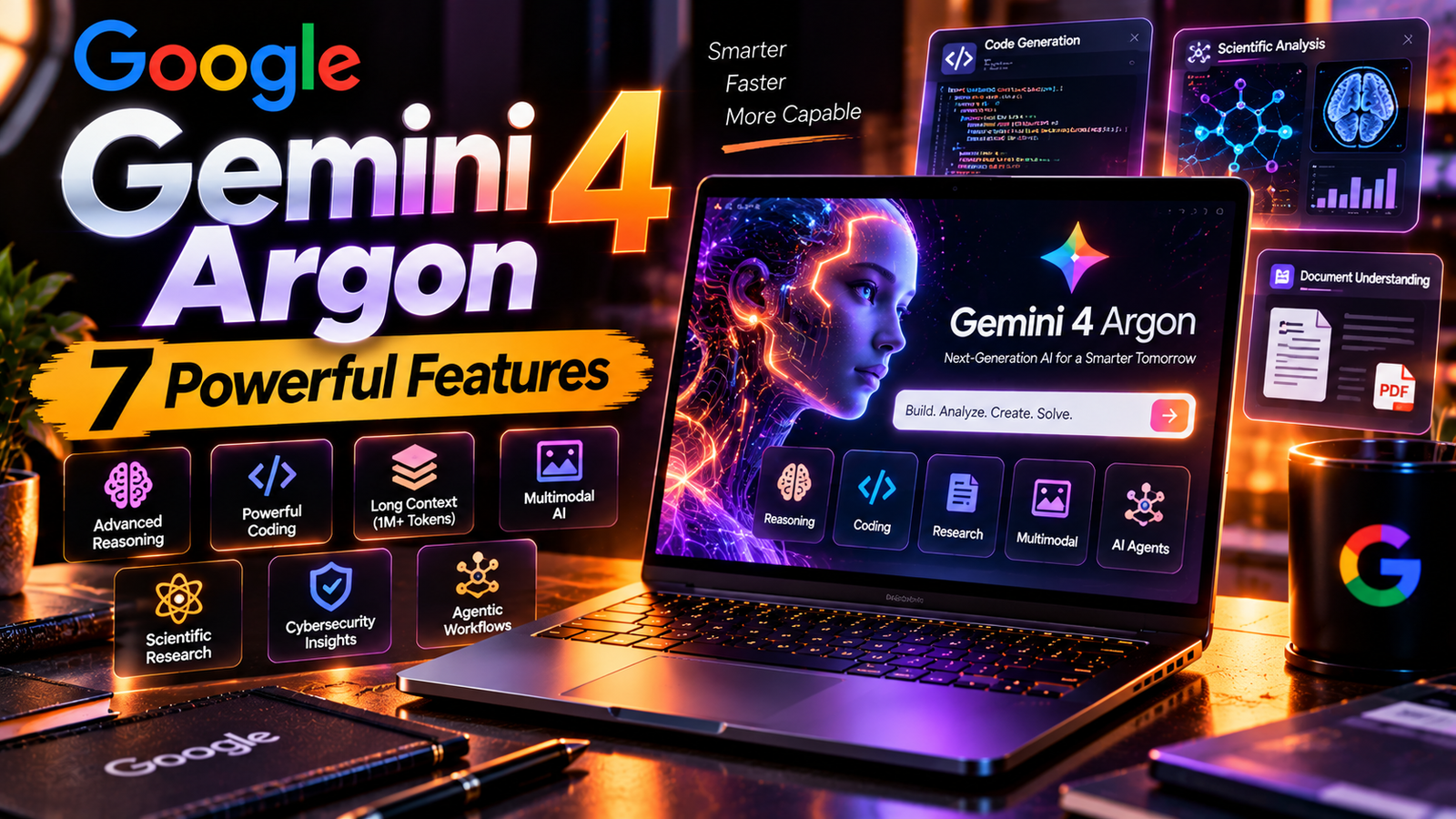
Artificial intelligence is moving beyond simple question-and-answer conversations toward systems that can help people solve complex problems, analyze information, and complete multi-step tasks. Google Gemini 4 Argon is Google’s frontier AI model designed for demanding work involving software engineering, scientific reasoning, cybersecurity, and professional knowledge.
Announced in October 2026, the model focuses on deeper reasoning, longer tasks, and complex workflows. It supports text, images, audio, video, and PDF inputs through its developer API, giving users multiple ways to provide information for analysis. Its long context capability also makes it relevant to projects involving extensive documentation.
For developers, researchers, businesses, and technology enthusiasts, Google Gemini 4 Argon introduces several capabilities worth understanding before choosing an AI model for a particular task.
This guide explores seven important features, real-world applications, pricing considerations, limitations, and practical ways to evaluate the technology.
What Is Google Gemini 4 Argon?
Google Gemini 4 Argon is a reasoning-focused artificial intelligence model from Google DeepMind. It is designed to handle complicated tasks that require more than a short response, including code analysis, scientific problem-solving, document research, and coordinated multi-step workflows.
The model can work with several input formats, including text, images, audio, video, and PDF files. This multimodal approach allows users to provide different kinds of information for a single task, depending on the interface and supported features.
Google positions the model for both individual and professional use. Availability differs by product: developers can access it through the Gemini API and Google AI Studio, while consumer access depends on eligible Google AI subscriptions.
For official details, visit the Google DeepMind announcement.
1. Advanced Reasoning for Complex Problems
One of the main attractions of Google Gemini 4 Argon is its emphasis on reasoning through difficult tasks. Instead of responding only to a simple instruction, the model is designed to analyze context, work through multiple steps, and produce structured results.
This capability can be useful when a developer needs to understand a complicated codebase, a researcher must compare several sources, or a business analyst needs to interpret a large collection of documents.
For example, a user could provide a technical problem, supporting documentation, and a set of constraints. The model can help organize the evidence, identify possible approaches, and explain the reasoning behind a proposed solution.
However, reasoning performance depends on the task, the quality of the supplied information, and the way the problem is presented. Users should verify calculations, assumptions, and conclusions rather than treating generated answers as automatically correct.
2. A Powerful Assistant for Software Development
Software engineering is a major area of focus for Google Gemini 4 Argon. Google’s published material highlights complex coding work, including large-scale refactoring, code optimization, and workflows that involve multiple development steps.
Developers may use the model to explain unfamiliar code, propose implementation strategies, identify potential bugs, or draft tests. It can also help break a complicated programming task into smaller pieces that are easier to review.
In an agent-based development environment, the model may help coordinate several actions, such as inspecting project files, proposing code changes, and testing a solution. The exact workflow depends on the development tool and permissions granted.
Generated code still requires human review. Test results, security implications, performance, and compatibility should be checked before changes are deployed to production systems.
3. A Long Context Window for Large Projects
Another important feature of Google Gemini 4 Argon is its unified input-and-output context limit of up to 1,048,576 tokens through the API. This gives the model room to work with substantial amounts of information in supported workflows.
A large context can be helpful when analyzing lengthy reports, technical documentation, research papers, or multiple project files. Instead of repeatedly supplying small sections, a user may be able to provide a much larger body of material in one workflow.
The context limit should not be confused with a guarantee of perfect recall. Large inputs can still contain irrelevant information, contradictory statements, or details that require careful verification.
To get better results, organize the supplied material, state the task clearly, and identify which facts or sections deserve the most attention.
4. Multimodal Understanding Across Different Formats
Google Gemini 4 Argon supports several forms of input, allowing users to work with more than plain text. Depending on the product and API configuration, these can include images, audio, video, and PDF documents.
This flexibility can be useful for summarizing a recorded presentation, examining a diagram, reviewing a document, or combining visual evidence with written instructions.
For example, a researcher might provide a PDF containing technical information alongside an image that illustrates a relevant concept. A multimodal workflow can help connect these inputs and produce an organized explanation.
The quality of the output depends on image clarity, audio quality, document structure, and the complexity of the task. Important figures, names, citations, and extracted details should be checked against the original material.
5. Applications in Science, Finance, and Legal Work
The professional focus of Google Gemini 4 Argon extends beyond programming. Google describes applications in scientific research, finance, legal analysis, and other knowledge-intensive areas.
In scientific work, AI may help researchers organize literature, compare experimental information, and generate ideas for further investigation. Financial professionals might use it to summarize reports or structure information for analysis. Legal teams may find document review and research assistance useful.
These examples demonstrate how AI can support information-heavy work, but they do not mean the model replaces qualified experts. Financial conclusions need appropriate checks, legal analysis requires professional judgment, and scientific claims must be evaluated using reliable evidence.
The most effective use is to treat AI as a research and productivity assistant while retaining human responsibility for important decisions.
6. Cybersecurity and Responsible AI Development
Cybersecurity is another area highlighted in Google’s announcement about Google Gemini 4 Argon. AI models can help security professionals examine code, identify potential weaknesses, and organize findings for further investigation.
For defensive teams, this could mean faster initial code review or assistance in understanding a complicated vulnerability report. AI can also help explain technical findings to people who need to understand their implications.
Security work requires particular care because model-generated results can be incomplete or incorrect. Suspected vulnerabilities should be confirmed through authorized testing, and remediation should follow established security procedures.
Google has also published a model card describing the model’s capabilities, limitations, and safety evaluations. Reviewing that documentation is useful for organizations considering the model for sensitive workflows.
Read the official Gemini 4 Argon model card for further information.
7. Agentic Workflows and Practical Automation
Google Gemini 4 Argon is designed to support tasks that may involve several connected steps rather than a single answer. In compatible tools, this can include analyzing information, using supported functions, interacting with files, and helping build a final deliverable.
For example, a project workflow might begin with a folder of research material, continue with a structured summary, and end with a draft report. An agentic system can help coordinate these stages, subject to the available tools and permissions.
Automation can save time, but it also introduces risks. A model might misunderstand an instruction, select an unsuitable source, or produce an inaccurate result. Actions that send messages, change files, or affect external systems should have suitable review and approval steps.
Start with a low-risk task, evaluate the output, and expand automation only after the workflow has proved reliable.
Where Can You Access Google Gemini 4 Argon?
Access to Google Gemini 4 Argon depends on how you intend to use it.
Gemini App
Eligible Google AI Pro and Ultra subscribers can access the model through the Gemini app, according to Google’s launch information. The available capabilities may differ by subscription and rollout.
Google AI Studio and Gemini API
Developers can explore the model through Google AI Studio and the Gemini API documentation. The API is intended for building applications and integrating model capabilities into software.
Google Antigravity
Google Antigravity provides an agent-oriented development environment where eligible subscribers can use the model for coding and related tasks.
Before choosing a route, review the current requirements, subscription eligibility, regional availability, usage limits, and billing terms.
Pricing and API Costs
For developers evaluating Google Gemini 4 Argon, API pricing is an important part of the decision.
Google’s published introductory pricing is $2 per million input tokens and $10 per million output tokens. The announcement states that these rates are scheduled to increase to $4 per million input tokens and $20 per million output tokens after November 30, 2026.
These rates apply to the specified public API model and should not be confused with the price of a consumer subscription. Actual costs depend on input size, generated output, caching, request patterns, and the service being used.
Before building a production application, estimate expected usage and review the latest Gemini API pricing information. Set appropriate spending limits and monitor consumption during testing.
Benefits and Limitations
The capabilities of Google Gemini 4 Argon may make it attractive for complex professional tasks, but no AI model is the best choice for every situation.
Potential Benefits
- Advanced reasoning for complex tasks.
- Assistance with software development and code review.
- A large context window for extensive documents.
- Support for multiple input formats.
- Help with research and professional knowledge work.
- Integration with supported developer tools and agentic workflows.
Important Limitations
- Generated information can still contain errors.
- Complex tasks may take longer or require several iterations.
- API usage can become expensive at high volumes.
- Access to certain consumer features requires an eligible subscription.
- Sensitive professional tasks need suitable privacy and security controls.
- Tool integrations and capabilities depend on the environment.
A good evaluation should use realistic examples from your own workflow rather than relying entirely on promotional demonstrations or benchmark rankings.
Is Google Gemini 4 Argon Worth Exploring?
For developers, researchers, and teams handling complex information, Google Gemini 4 Argon may be worth testing because of its reasoning focus, long context, and support for multimodal inputs.
A useful evaluation begins with a small set of representative tasks. Test how accurately the model analyzes documents, handles code, follows instructions, and produces results that meet your requirements.
Compare its performance with the time and cost required to verify its work. A model that generates a fast answer but requires extensive correction may not deliver the expected productivity improvement.
Organizations should also review data-handling requirements before sending confidential information to an external AI service.
Final Verdict
Google Gemini 4 Argon is Google’s latest frontier model focused on complex reasoning, software engineering, scientific work, and multi-step tasks. Its large context window and multimodal input support make it relevant to developers and professionals working with substantial amounts of information.
Its real-world value depends on accuracy, integration, pricing, and the suitability of the task. It should be treated as a capable assistant rather than an infallible decision-maker.
For the best results, test the model against real requirements, verify important outputs, and review Google’s current documentation before integrating it into a critical workflow.
Read more: Breaking the Rules: Artists Who Redefined Traditional Techniques
Frequently Asked Questions
What is Google Gemini 4 Argon?
It is a Google DeepMind AI model designed for complex coding, reasoning, scientific problem-solving, and professional knowledge work.
What is its context window?
The Gemini API documentation lists a unified input-and-output context limit of up to 1,048,576 tokens, with long-output support depending on the request configuration.
Can it help with coding?
Yes. Google highlights software engineering tasks such as code analysis, refactoring, and optimization. Generated code should always be reviewed and tested.
Does it support images and documents?
The API supports text, image, audio, video, and PDF inputs. The exact experience depends on the interface and enabled capabilities.
Is it free to use?
Access depends on the product. Some consumer features require eligible paid subscriptions, while API usage is billed according to the applicable pricing rules.
Where can I learn more?
Start with the official Google announcement and the Gemini API documentation.
